
Robeson County Criminal Court Records
A criminal court record is the case file maintained by the Clerk of Superior Court once a criminal matter is filed in court. In Robeson County, criminal files may include a warrant or criminal summons after filing, charging documents, citations, bond conditions, docket entries, pleas, motions, orders, trial settings, judgments, probation terms, sentence details, costs, and final disposition. The record follows the court case, not just the first arrest event.
The official criminal cases image below links to the North Carolina Judicial Branch help topic for criminal court process.
That state source helps frame Robeson County criminal court records as case files with court events, not as a sheriff booking log.
Robeson County criminal matters are heard within North Carolina's unified General Court of Justice. Superior Court handles felony criminal cases and appeals from District Court. District Court handles misdemeanors, infractions, traffic-related criminal matters, and magistrate-linked criminal process. Magistrates may be involved in initial process and bond. The District Attorney prosecutes for the State, and the Clerk of Superior Court keeps the resulting public case file when it is not restricted.
Search Robeson County Criminal Court Records
The main online search path is the North Carolina eCourts Portal. Smart Search can be used for criminal actions by defendant name or case number, and Search Hearings can be used to locate court dates by party, case number, attorney, judicial officer, or courtroom. Criminal case information can also be accessed at public self-service terminals in clerk offices, and paper files can be viewed in the county where the case is located.
- Open eCourts Portal and choose Smart Search for case records.
- Search by defendant name or case number, using Robeson County as a location filter when available.
- Use case type, case status, date of birth, or filing-date filters if the result list is broad.
- Review charges, docket events, hearing entries, disposition, costs, and sentence-related fields.
- Request a certified copy or paper file access from the Robeson County Clerk of Superior Court when an official document is needed.
Portal records are not a substitute for an official criminal background check. The Judicial Branch says people performing background checks should use the county clerk's office instead of relying on Portal alone. For statewide prison, probation, or parole records, the N.C. Department of Adult Correction has separate offender searches, but those records do not replace Robeson County criminal court records.
Robeson County Criminal Case Stages
A Robeson County criminal court record grows as the case moves through court. An arrest or summons may begin the path, but the case file becomes meaningful when the charge is filed, scheduled, answered, amended, dismissed, tried, pled, or sentenced. Each stage can create a docket entry or document. Some stages may be brief. Others may involve repeated settings, motions, continuances, or amended charges.
Case flow: Charges Filed › Arraignment › Pretrial / Motions › Plea or Trial › Disposition › Sentencing
| Stage | What Happens |
|---|---|
| Charges Filed | A warrant, summons, citation, indictment, or other charging document enters the court record. |
| Arraignment | The charge and plea are addressed, and the record may show a plea entry or next setting. |
| Pretrial / Motions | Attorneys may file motions, request hearings, seek continuances, or address evidence and procedure. |
| Plea or Trial | The case may resolve by plea, trial verdict, dismissal, or other disposition. |
| Sentencing | The judgment may show probation, incarceration, costs, fines, restitution, or other court-ordered terms. |
What Robeson County Criminal Records Show
Criminal court records in Robeson County should be read field by field. A charge list alone does not show guilt. A disposition may apply to one count but not another. Costs and bond fields may change. A case may have multiple settings before a final result. The most reliable reading pairs the case summary with docket entries and, where needed, the paper file or certified copy from the clerk.
| Field | What It Shows |
|---|---|
| Case Number | The statewide case number, often with criminal case-type letters and county identifier. |
| Defendant | The person charged in the criminal case, with public identifiers limited by access rules. |
| Charges | Offenses filed in court, which may be amended, reduced, dismissed, or resolved separately. |
| Bond Conditions | Release or custody terms where entered into the court case record. |
| Plea | The defendant's formal response, such as guilty or not guilty, when recorded. |
| Docket Events | Hearings, filings, motions, orders, continuances, waivers, and trial settings. |
| Disposition | The current or final outcome, such as guilty, not guilty, dismissed, or another case result. |
| Sentence | Punishment or conditions after conviction, including costs, fines, restitution, probation, or custody terms. |
Robeson County Prosecution Roles
Prosecutorial District 20 covers Robeson County. The District Attorney for the Twentieth Prosecutorial District is Matt Scott, and the local Contact Directory lists the District Attorney at (910) 272-5910. The District Attorney represents the State in criminal prosecutions. That office decides prosecution strategy and appears for the State, while the Clerk of Superior Court maintains the case file and the Public Defender or appointed counsel may represent eligible defendants.
The District Attorney source image below links to the official Prosecutorial District 20 page.
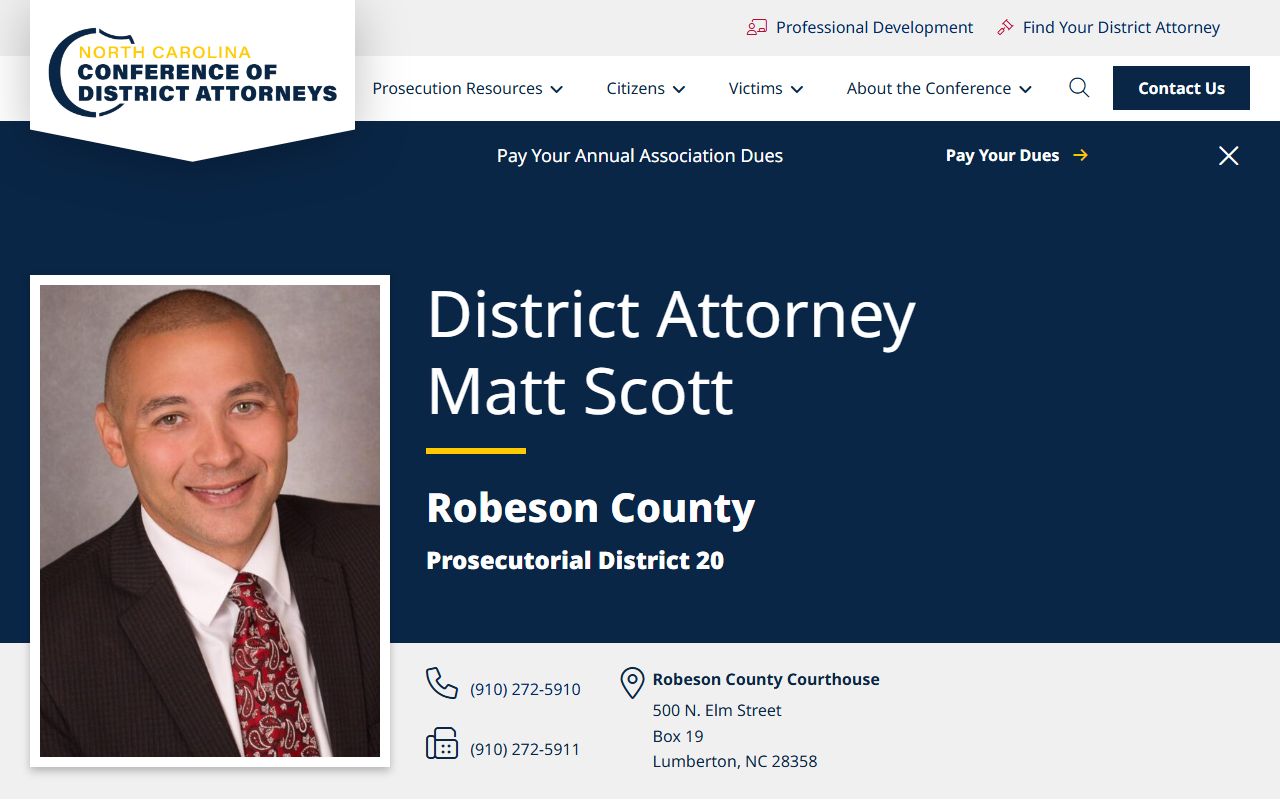
This source is relevant because Robeson County criminal court records often reflect charges and dispositions shaped by prosecutorial action.
The Robeson Defender District 20 page names Public Defender Jack Moody and gives the Public Defender Office phone as (910) 272-5923. That office is part of the defense system for eligible indigent defendants. It is not a public records office. Record access should still be routed through Portal, clerk terminals, or the Robeson County Clerk of Superior Court.
The Public Defender source image below links to the North Carolina Indigent Defense Services Robeson County page.
That office information helps explain the roles shown in criminal court files without treating defense counsel as a record custodian.
Robeson County Charges vs Convictions
A charge is an accusation filed in court. A conviction is a final result after a guilty plea, verdict, or other conviction event. A Robeson County criminal court record may show charges that were dismissed, reduced, amended, or resolved differently from other counts in the same case. The full case result is therefore more important than the first charge line.
| Charge | Conviction | |
|---|---|---|
| Stage | Begins as an allegation or court-filed count. | Appears after a guilty plea, verdict, or other conviction result. |
| Proof level | May begin with probable cause or charging authority. | Requires a court result that supports judgment. |
| Record meaning | Does not prove guilt by itself. | Can support sentencing, costs, probation, or other judgment terms. |
| Best field to check | Charge status and docket entries. | Disposition, judgment, and sentence fields. |
Sealed and Expunged Criminal Records
Some Robeson County criminal court records are restricted. Juvenile records are not treated like ordinary adult criminal records. Sealed records may be hidden by law or court order. Expunged records are removed from ordinary public access if a court grants relief under the correct statute. Public Portal searches and clerk terminals may not show these records or may show only limited information.
The expunction source image below links to the official Judicial Branch expunction help topic.
The expunction topic is important because Robeson County criminal court records may disappear from public access when a valid order is entered.
| Sealed | Expunged | |
|---|---|---|
| Public visibility | Hidden or limited by law or court order. | Removed from ordinary public access after statutory relief. |
| Common reason | Confidential case type, safety rule, juvenile status, or court order. | Dismissed charges, not-guilty results, first-offender categories, or eligible convictions. |
| Access result | May still be available to authorized users. | May remain available for narrow statutory or federal uses. |
| What to do | Ask the clerk or court about authorized access. | Use official expunction forms and legal advice when eligibility is unclear. |
Public Access to Robeson Criminal Records
North Carolina public court access for Robeson County criminal court records is shaped by N.C.G.S. Chapter 132, N.C.G.S. 7A-109, and confidentiality statutes that apply to particular case types. Criminal investigation records have special access rules under N.C.G.S. 132-1.4, but certain arrest and charge information can remain public. Court case records and law-enforcement investigative records should not be merged into one source.
Note: Public access does not mean every criminal case document is online, complete, or available without clerk review.
For a narrow look at court charges after arrest, use the Robeson County arrest records and charges page. For all civil, criminal, estate, family, traffic, and judgment records in one place, use the broader court records page. Those distinctions help keep arrest data, charge records, and final criminal case outcomes from being confused.